One of the greatest dreams of men is to discover and explore other planets. There is, however, an ecosystem that, although being on our Earth, for all intents and purposes can be compared to another planet. A world in which life for humans and other mammals is impossible, but at the same time holding a variety of life species uncomparable to anywhere else. An environment which was the cradle of life for all living species. Have you guessed yet? I’m talking about the realm of the oceans. Diving enthusiasts will know what I mean. And for those of you who have never tryed diving, my advice is to try as soon as possible. It took me 26 years to get around to do it and now... I am hopelessly in love.
The location of our initiation to the underwater world was Nha Trang, in central Vietnam. Nha Trang is the premier beach resort in the whole country; set on an enviable location on the South China Sea, whose deep blue waters attract me so much more than the Andaman Sea or the Gulf of Thailand. The town itself is nothing to write home about. Vietnamese and foreign investors went through a building frenzy in the last few years, with the result that now the town resembles a baby Surfers Paradise. High rise hotels line the pretty palm-fringed beach, but every cloud has a silver lining; increased competition means lower prices, and good service. After a spot of haggling we scored a rooftop room with adjacent 25 square meters terrace for the dong equivalent of $11... not bad.
For us however, the beach and the hotel room were of secondary importance. We’d come for the diving. And so, early on the morning for 5 days in a row, we jumped on a boat bound for the Hon Mun Maritime National Park, in the company of our diving instructor Jens. Keen as we were to start diving as soon as possible, we decided to skip the induction day in the swimming pool. And so, after a quick theory lesson, we jumped in donning all our gear. My first sensation of being underwater was not at all good. I could not get used to breathing through the mouthpiece, I felt like choking. Moreover, I could not appreciate the sensation of weightlessness; the weight belt was digging on my hips and the air tank sat uncomfortably on my shoulders. I guess it was just my reaction to a novel sensation, as after my second dive I absolutely loved being underwater. Jens said both of us looked instantly comfortable underwater, being able from the beginning to control our buoyancy. And over 5 days we completed both the Open Water and the Advanced course. The experience was one of the greatest I’ve had in my life, and will surely redefine the way we travel. Unfortunately, diving is rather expensive, but worth every penny in my mind.
Let me tell you, Nha Trang is no Borneo or Red Sea. The marine life looked fantastic to us, but underwhelming to other seasoned divers who joined us on the boat over the 5 days. We did see a variety of corals, colorful fish including the peculiar looking (and rather dangerous) lionfish, an extraterrestrial underwater squid and sea cucumbers, the softest thing I ever touched (ok, I know it’s naughty to touch sea creatures). We dived down to 30 meters, appreciating the darkness and otherwordly feeling, although I admit sea life is more impressive around 12-15 meters of depth. During my favourite dive we visited an underwater cave, teeming with schools of fish that opened like theatre curtains to let us past. The only regret we had was being unable to capture anything on camera, as we have no underwater equipment... a problem that, according to Nick, will soon be rectified.
As I said before, it was not what we saw that overwhelmed us, It was the actual sensation of being underwater. I’ll try to explain that. Jumping into the water with all the gear, one feels rather clumsy and constricted in one’s movements. But once all the body is underwater... we all become a cross between ballerinas and astronauts. The body has no weight; we can float and dance gracefully, roll on ourselves or do backflips, as the body is permitted a much wider range of movements than on land. It feels like flying. I enjoyed the feeling of my body way more than I enjoyed anything we saw during the 5 days. In a way, Nha Trang for me was the ideal place to learn diving. And I’ll never forget the time spent there, that’s for sure.
Wednesday, 16 June 2010

Monday, 10 May 2010
Bia Hoi and pho


Saigon/Ho Chi Minh city. You choose. I chose Saigon, I think I'm quite old fashioned. I still call Indian cities by their colonial name, Bombay, Calcutta and Benares; Myanmar for me is still Burma. I do not mean to be disrespectful towards the locals, but I discovered these places with Kipling and Orwell, so I'll use the names they use. Plus Rangoon sounds way more evocative than Yangon, Madras is a much nicer name than Chennai. Saigon is rather different, it's been the city's name for centuries, until the end of the war and Reunification. So what a better place to name after the fallen Uncle Ho than the centrepoint of American resistance? Unfortunately, Ho didn't live to see the day. Altough Vietnam's capital is officially Hanoi (anybody familiar with recent history will know why), Saigon is the commercial centre, the largest and liveliest city.

I loved Saigon instantly. I have a fondness for Asian cities; I love the street carts, the atmosphere, the Buddhist and Chinese temple. I love the energy, the sense of being 'on the move'. Saigon was a good example; it doesn't have many sights as such, but it's just nice to be there. Try crossing the road, for example. A sea of bicycles, cyclos, motorbikes and the odd car is between you and the other side. A current that gives no sign of stopping or even easing. Plus, no traffic light. How do you do it? Slowly, step by step, steadily. What a metaphor for life and seemingly unachievable tasks. When something looks as daunting as a Vietnamese road, just take the first step and keep going. The first step is the hardest, once you've started, you're halfway there.


Most sights in Saigon are war or Revolution related. We visited the Reunification Palace, the former presidential palace who was stormed by Vietcong on the day Saigon fell. The palace itself was nothing spectacular, a rather nondescript building with 60s furniture, but it was interesting to see how the basement was used as headquarters for the South Vietnamese intelligence. The War Remnants Museum was another story. It used to be called American War Crimes museum, giving an idea of the exhibits. There were pictures of napalm and Agent Orange victims, wounded soldiers and civilians, the devastation of the war. What impressed me mostly was an account of how Agent Orange, the defoliant used plentifully be the American army, has caused birth defects for years after the war was over. Pictures of children and young adults with crooked or missing limbs, cleft palate or other facial deformations covered a whole wall. There were even two foetuses in formaldehyde; one of Siamese twins, one with a head deformation. I left shaking. I was also shocked by the images of the My Lai massacre, the murder of a whole village by the hand of American soldiers. Nearly 500 children, women and elders were killed; accused of being VC supporters. Sarcastically, the following quote from the US declaration of independence was displayed nearby
"we hold these truths to be self-evident, that all men are created equal, that they are endowed by their Creator with certain unalienable rights, that among these are Life, Liberty and the Pursuit for Happiness"


On a lighter note, my time in Saigon will also be inextricably linked to the discovery of two new flavours; pho and bia hoi. Pho is the quintessential Vietnamese soup; half cooked beef in a rich broth, with rice noodles and a variety of ingredients that can be added at will, such as beansprouts, mint leaves, various tangy and bitter green leaves, chilli and plum sauce, plus a squeeze of lime juice. Rich and nourishing, perhaps the best soup after Penang. Bia hoi, on the other hand... will probably remain as my memory of Vietnam. Roughly translated as 'fresh beer', bia hoi are microbreweries, offering jugs of draught beer for 12.000 dong (less than 50 euro cent). Tables are bunched up together on the pavement; conversations inevitably flourish. The people watching was my favourite activity. From my streetside seat I saw an endless procession of cyclos, streetvendors selling anything from sunglasses to mangosteens, American veterans that came during the war and stayed. A reclined my plastic stool and enjoyed the show; a snapshot of life in Saigon, or Ho Chi Minh City.

Elephant ear fish


Like durian and marmite, Vietnam seems to be another place that travellers either love or hate. Why? I hared lots of different reasons, from the quicker pace of life, to the relentless harassment, to the lack of veggie food. All valid reasons, I guess. I was just about to see for myself. A short and expnsive ride from Kep took us to the border, and since there to the border town of Ha Tien. The difference with Cambodia and Laos couldn't have been more obvious. Firstly, Vietnamese look different from the rest of SE Asians. They are more slender and fair-skinned, more Chinese-looking. Ladies are absolutely stunning. Friendliness is not easy to detect for a newcomer, business seemed to be Vietnamese's only concern. Join this mindframe with the presence of Westerners and you get the result; ripoffs, harassing and the ubiquitous 'where you go?'... needless to say I was quickly losing my temper. I was not liking Vietnam.


Shame, though. I always pride myself of being able to find a good point, everywhere I go. But after that first day, Vietnam was looking like a tough challenge. I found myself haggling over bus rides and bottles of water. I felt like everybody out there wanted to rip me off, to get that wee bit extra as 'white tax'. It bothered and enraged me. That evening, a tout quoted $ 25 for a boat trip around Can Tho's floating market. 25 dollars! you must be joking! I said. He did not seem to budge at first. Eventually, we paid about 10 dollars for the trip.

Anyway, that's the background. The first three days in Vietnam were spent mourning our depatrure from Cambodia, wishing we were still there. We were in the Mekong delta, travelling to Saigon via Can Tho and Ben Tre. The Mekong delta was far from being the 'bucolic paradise' described by guidebooks. Can Tho and Ben Tre (who was suggested as being a 'lovely little relaxing place) were in fact medium-sized towns, clogged with traffic and with septic bubbling 'rivers'. What a sad demise for the mighty mekong, who greeted us into Laos, followed us down the spine of Indochina and into Cambodia. I could not believe that the emerald-coloured waters of Don Det, the teal expanse separating Laos and Thailand at Pakse and Vientiane was the same river we saw in the delta. Ok, if we want to be precise, it's not. The murky waters at can Tho seemed to be carrying the sorrows and troubles of Indochina into oblivion. Like a tired old woman, bidding farewell to life.

We did the Mekong delta thing, floating markets. I loved the market we saw, it looked authentic, not a tourist show like Damnoen Saduak near Bangkok. Plus we had the best pineapple I have ever tasted. But besides that, everything was rather dull. Boat tours everywhere, visiting the same old handicraft shops, factories and orchards. Like I came to Vietnam to see some bloody fruit trees! We have to thank the organised tours from Saigon for this. Anyway, we also passed on the classic mekong delta activity, homestay, when we learnt it was $10 per person. I like homestays, but I don't see the point of getting out of one's way to stay at someone's house. It's always the same old story at the end of the day.

So we headed for Ben Tre, the 'lovely relaxing little place'. After multiple rip-off attempts and a near-death experience thanks to a drunk moto driver, we reached the guesthouse we had chosen. It was a bit shabby around the edges, but nice. For dinner we had their 'world famous elephant ear fish'; a large freshwater fish fried and served with spring roll wrappers and a variety of vegetables, plus fish sauce (the real stuff). They even had snake and turtle on the menu, but the price put us off. Anyway, the fish was delicious, the family really friendly. I decided Vietnam was not so bad. Did I or did I not like it? Keep following me and find out...


Wednesday, 5 May 2010
Crab in Kampot pepper, and the ghost house


There was another place I wanted to visit in Cambodia. I had once seen the picture of a decrepit building, surrounded by mist and seemingly lost in the jungle; for a long time I wondered where it was. The place was Bokor Hill station, near Kep. Only 5 of us reached Kep, having lost 2 on the way. And for everybody, Bokor was up there on the list. Kampot is a quaint and relaxing town, lying riverside with an interesting collection of French colonial buildings. Touristy enough to have good guesthouses, but out of the Siem Reap-PP-Sihanoukville axis and the interminable street peddling attached. It was nice enough to spend a few hours wandering around. We discovered Cambodian durians were in season. My readers will be familiar on my keenness for the king of fruit; a love that is rarely found in Caucasian people. In most cases, when Westerners sample the delectable flesh of this beautiful fruit, they either gag or lying through their teeth say 'it's alright'. If there ever was one thing that you can either love or hate, that's durian. Nobody who is speaking the truth would ever define it as 'alright'. I love it, and needless to say I stuffed my face with it.


But onto Bokor now. We arranged a trip there the previous day, and found out it was an all-day affair including a five hours trek. Why? Courtesy of the omnipresent Sokha group, who purchased the land to build a Las Vegas style resort on the grounds of the former hill station, hence closing the access road. Doesn't matter that the surrounding area is protected National Park. What is done for the tourist dollar (or shall I say yen, or yuan? I like to think no Westerner in their right ming would ever stay in such an environmentally-unfriendly eyesore). See, I fall into my old ways, ranting whenever I get the chance. Let me explain. Bokor Hill Station was built by the French in the 1920s as a hill station, to complement Kep-sur-Mer, lying a few kilometers away on the coast. In a typical European view, the hill station was built to provide dignitaries and important visitors to the colony with the possibility to escape the heat and enjoy the fresh air. It occupies an enviable position, perched on a cliff overlooking the ocean over a thousand meters below. The resort was in full swing until the late 1940, when the French abandoned it retreating from Indochina. It was still sporadically used, until the Khmer Rouge takeover when it became an operation base. It was one of the sites of heaviest fighting during the Cambodian-Vietnamese war that marked the end of the Khmer Rouge. Subsequently, it was used as a hiding place for the last pockets of Khmer Rouge, who only abandoned the area in the late Nineties.


I especially enjoyed having to hike to get to the station. As I said, the access road was closed, so we followed a very rough and steep trail until two-thirds up the mountain, from where we were picked up by a truck for the final strech. The hike was uneventful, but enjoyable nonetheless. As always, when the road is hard, the reward is higher. And up the top, the view was spectacular. The centrepiece of the station is the former Bokor Palace Hotel, which is now in ruins, but still standing proudly on its prime position by the cliffside. We walked around the building, pausing to eat a lunch of fried rice in the former ballroom. The ballroom had a staircase leading onto the garden backing onto the cliff. My imagination started wandering, aided by the silence and eerieness of the location. I imagined Gatsbyesque parties, Kir Royales at sunset, dramas, loves lost and found. Relics of times gone by, when men wore hats and there was always a piano player in the background.

However, this is only one side of the story. What was a temple to joie de vivre became a theatre for the atrocities of war. Bullet holes covered these once-magnificent walls. The stairways where beautiful ladies strolled on their ways to a ball were now collapsed. The luxurious hotel was reduced to a burnt and blackened shell. Still, the atmosphere of decadence was captivating. Our guide explained that Sokha decided to move the construction site further away from the Palace Hotel because the area is haunted. Buddhists believe that those who aren't given a proper burial will remain on Earth as spirits; plenty of people died on the grounds and, supposedly, still remain there. From the ghosts of Khmer Rouge or Vietnamese soldiers, to the spirits of those who lost so much in the hotel's casino that were left with no choice but jump to their deats on the cliffs below. Will the well-heeled customers of the future deluxe resort have sleepless nights? Who knows, perhaps serves Sokha right for building such an obscenity in National Park territory. However, my comment coud prove to be narrow-minded. I asked our guide on hs opinion about the Sokha resort, and he replied making reference to the amount of jobs the resort will give to local people. I guess it's a fine line, balancing the need for environmental protection with a desire to help local economy. Somewhat, I don't think this is Sokha's primary concern, but there you are. That's yet another story.

Fast forward a couple of days, and we're in Kep, our last destination in Cambodia and the place where we bade farewell to the rest of our travelling buddies. Kep was the seaside's answer to Bokor during colonial times. Nowadays, it has developed into a nondescript Cambodian town, although the relics of colonial villas remain. The stretch of coast is pretty uninspiring too, vaguely reminiscent of Cote d'Azur with the sea splashing on rocky cliffs, which quickly turn into verdant hills. None of the broad sandy Southeast Asian beaches. With a sunset walk and a meal of crab fried in Kampot pepper, we bade farewell to our companions and yet another chapter of our travels. Good morning Vietnam, the adventure continues.

Monday, 3 May 2010
Grilled squid and crayfish, or dangerous snorkelling

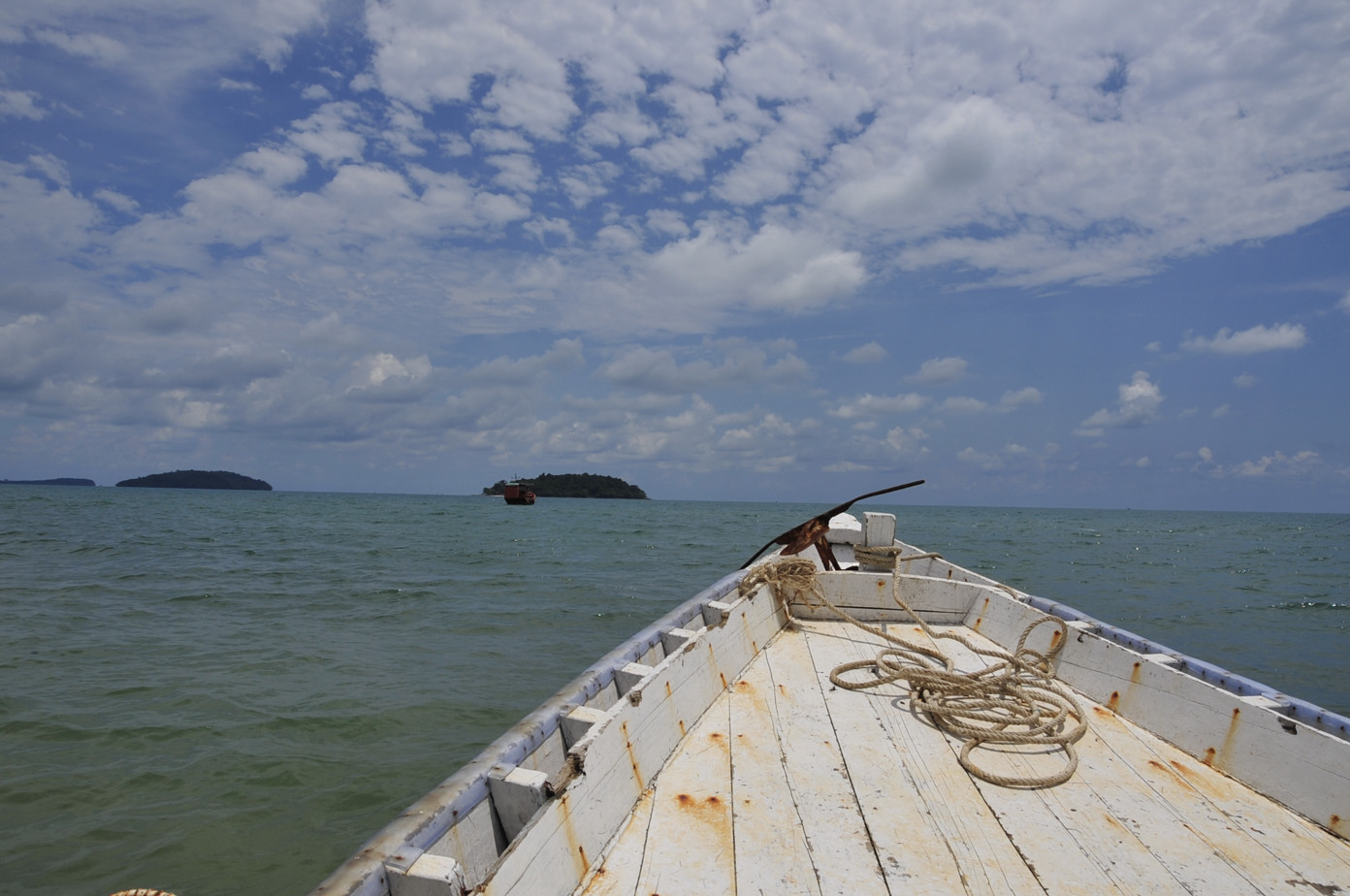
Everybody knows I'm not a beach person. I shun the typical 'backpacker activity' of bumming around Thai islands for months on end, searching for the 'beach' (maybe a certain movie and book have someting to do with it?), only to find flimsy overpriced bungalows, average falang food and expensive beer. I don't enjoy lying in the sun, getting wet every now and then (watching out for sea urchins and jellyfish!) and finding my bed in the aformentioned flimsy bungalow full of sand. Give me an Asian capital, a market, temples, food courts and treking, and I'll be set. I'll leave the beach to the gap-yearers. Nick agrees with me, he is possibly even less keen, as he doesn't enjoy swimming. So it will probably come as a surprise to hear we spent an amazing week in the Cambodian south, between Sihanoukville, Kampot and Kep.

There was this bunch of people we kept crossing paths with, since Southern Laos. That's one of the wonders of travelling; like-minded people are easy to find, and easy to meet again as most people follow the same itinerary around South East Asia. We met these people again in Siem Reap and Battambang, and decided to visit the south of Cambodia together. First stop was Sihanoukville, the premier beach resort on Cambodia's diminutive coastline. Probably not a destination I would've chosen for the two of us, but the prospect of spending a few days in company of others looked rather inviting. The bus trip to Sihanoukville showed the advantages of travelling with a 'group'. As it happens, the bus broke down. We waited on the roadside whilst the damage was assessed, various repairs were attempted (and failed), and finally whilst a replacement bus was sent from Phnom Penh. A 4 hours wait for a 4 hours bus trip. However, between a game of hearts and one of 51, waiting by the roadside was never so enjoyable.

To cut a long story short, and not bother you all with the same 'been there, stayed in such and such guesthouse' babble, I'll skip to our final destination, Otres Beach. We spent three days with a lot more Hearts, card games and small talk. We watched the sun set in the sea every evening, ate fish tacos and drank beer with our feet in the sand. Every lunchtime we had grilled squid and crayfish from two lovely ladies hawking their produce along the beach, certainly up there in the 'top 5' street food I have had in all these months. The only blunder was a snorkelling trip we took. The boatpeople, however friendly and lovely, were clearly inexperienced and anchored on a reef, one of the first and foremost environmental no-nos. And the water was far too shallow, resulting in multiple injuries for the snorkellers. And to top it off, it started to rain. I have forgotten to mention that the wet season is starting, and since Battambang has rained nearly every day. The rain comes in downpours which last from a few minutes to an hour, usually offering some respite from the stifling heat. However, with a few bloodied feet and generally a low morale, the downpour in this case was less than welcome.

Somewhat, there is a completely unrelated topic I wish to mention. I have spoken about Cambodia's poverty, and the subsequent willingness for some locals to make a 'quick buck'. This phenomenon had a dual consequence for me and my image of Cambodia and Cambodians. On one hand, I was bothered by the continuous offers of 'you buy?', yes, I have been rude to some of the vendors, especially with those trying the 'emotional blackmail' card. On the other hand, it made me sad, thinking that the myriad street peddlers are not the only ones who suffer. Say, living in Siem Reap and hawking around the temple, one is pretty much assured to return home with a few dollars at the end of the day. In rural Cambodia, I'm not so sure. There are plenty who suffer without flaunting it, because they do not even have the possibility to do so.

And I'll tell a story now. In Otres beach I met Rowan (not sure about the name's spelling), a beautiful 24-year old who ran the guesthouse we stayed at. She studied accounting and was keen to chat in English. I noticed some baby paraphernalia in the beach hut where she lives with her husband, and inquired after the baby. She said, he's dead, at 5 months. She pointed at the phone receiver and said 'he was this big'. Then, I realised she was talking about a stillbirth, and quickly said 'nevermind'. I recalled talking to another woman in Siem Reap whose baby also died at birth. In three weeks in Cambodia, I met two women who experienced stillbirths. In 25 years in the West, I never met any. But what caught me was the way both women seemed absolutely not bothered by the fact they had lost a child. They both accepted their fate, blaming their children's death on inadequate and unaffordable medical care.

This episode made me think about what we need as human beings. A Romanian man once said to me 'the most important things in life are health and freedom'. Too many people nowadays worry about trivial things, and in this I include work. Too many people work just to put more money in already-full pockets, when at the same time, there are women in Cambodia who are unable to give birth safely, for whom a child's death is nothing more than just another accident in the struggle for life.


Monday, 19 April 2010
The horrors of Cambodia

Tragedy in history always hits the nicest people. Come to Cambodia, and you'll find it hard to disagree. Wherever you walked you'll be accompanied by smiles; gappy, toothless and flawless. But you'll also notice the abuidance of youngsters, and the paucity of people above the age of 40, generations missing. Those familiar with history will know why. For those who aren't, I will use this blogpost to introduce you to the Khmer Rouge and the Cambodian genocide.

Timeframe: the early Seventies. China has just taken the Great Leap Forward, Vietnam is slowly defeating the USA. The Cold War is at its highest; Communism seems like a viable option. In Cambodia, Prince Sihanouk has been deposed and a uber-corrupt republic is in place. In the meanwhile, American bombings in Vietnam have extended beyond the Cambodian border. A group of Cambodian intellectuals, who have spent years studying in Paris some 20 years previusly, have become fascinated by Marx and Engels' writings. Back to Cambodia, they form the Khmer Rouge, a political-military group fighting the Republican Army. They finally succeed, Phnom Penh falls on April 17th, 1975. The horrors begin.
Cities are emptied, money and banks are abolished, families are separated, everybody has to wear black. Religion is abolished, monks are forced to disrobe or killed. Colours cease to exist, alongside any remnants of personal liberty. The goal of the new regime is to create a self-sufficient agrarian society. Everybody is relocated to the countryside, to grow rice. People with skills are considered potential enemies, and are quickly eliminated. Their children are also killed, to prevent the possibility of revenge. Others, children included, are forced to work up to 18 hours a day. However, lack of agricultural knowledge of most relocated people and the impossible goals set up by the party cause famine, disease and death. The rice produced is used to pay debts, especially with China and Korea, leaving people with only a few ounces a day. Because of the party's goals of self-sufficiency, there are no medicines or hospitals. Most doctors and nurses are killed because of their education. In only a few months, Cambodia has reached its darkest time.

After three years, 8 months and 20 days, the regime ended. Between 1.5 and 2 million Cambodians died, either killed by the Khmer Rouge or succumbed to starvation or disease. What is left is a broken country. Phnom Penh still bears the scars of these horrors. Tuol Sleng, a former high school converted into prison, is now a museum to the genocide. Nearly 20,000 people were imprisoned at Tuol Sleng, known as S-21 prison. Only 7 survived. We visited the museum, which still hosts the cells used to confine the captives. We saw the mugshots of prisoners; children and babies could also be identified as 'enemies of the country'. The atmosphere was dark, thick, I felt almost breathless. I could sense the suffering, the screaming and the despair that went on behind these walls. Then we headed to the Killing Fields. Thousands of people were killed, shot in the first part of the war, then clubbed with hoes, sitcks or other implements. Babies were swung on a tree until their skulls smashed. The Khmer Rouge did not even gave these people a quick, painful death by a bullet. Wandering around the mass graves, fragments of bone, cloth and teeth poke through the ground. The tragedy suddenly felt tangible, beyond real.

Now, fast-forward 30 years. Cambodia's economy and cities are still being rebuilt. This is a counrty who has witnessed some of the most atrocious occurrences of the 20th century. Still, the smiles accompany you wherever you go. Please, my dear reader, I beg you, if you visit Cambodia do not hide behind a blanket of ignorance. Don't be marvelled by the Temples of Angkor without visiting Tuol Sleng prison and the Killimg Fields. History cannot be undone, don't pretend it hasn't happened. The fallen deserve to be remebered.

Saturday, 17 April 2010
Steak and guinness pie, or the beauty of Cambodia


Siem Reap was our first stop in Cambodia, after a 18 hours odyssey from Laos. By far, Siem Reap is the most heavily touristed place in Cambodia, and for a reason; the temples of Angkor. Almost single-handedly putting Cambodia back on the tourist radar after the atrocities of the Khmer rouge, the temples of Angkor are truly one of the wonders of the world, a spellbinding sight. Unfortunately, as with all tourist centres, the bad and the ugly go alongside the good. Beggars and children hawkers are at every street corner and behind every temple stone. Poor buggers though, trying to make a living in one of the poorest Asian countries where the average salary is $20 a month. A $1 transaction would mean the world to these people. Unfortunately, one of the golden rules of responsible travellers is not giving money to children.

That didn't bother me nearly as much as the 'guesthouse mafia' did. An army of touts and shady characters roams around Siem Reap, trying to make a quick buck from the stupid falang. Every price is hyperinflated, guesthouses, tuk tuk and even water or drinks. One finds that the person negotiating is never the person providing the service; rather, they are just middleme, charging a dollar or two just for 'being there'. I hated it. We did arrange a tuk tuk with the seemingly personable guest house receptionist which claimed to be a driver, only to find a surly teenager waiting for us on the following day. After he did not want to take us back into town for respite from the heat, we sacked him. There was no argument at our refusal to pay him for the day; he probably had another job lined up thanks to Mr Tout.

But the temples more than made up for it. From the eerie early morning quietness of Prea Khan, to the faces of Bayon, the struggle with nature at Ta Prohm and the carvings at Banteay Srei; the Temples of Angkor are perhaps the most spectacular man-made wonders I have ever witnessed. But one beats them all. Angkor Wat. There are no words to describe the sheer majesty of the place, the feeling of seeing it appear beneath a pink sky at sunrise. It is the largest building of the world, and maybe the most spectacular sight ever conceived by the human mind. Surrounded by a moat 190m wide, and a wall 3.6km long, it is not comparable to anything else I have ever seen. It made me want to bow to its majesty, at the same time being as welcoming as a mother. Angkor Wat is a dream.

There's nothing more to Siem Reap than the temples. Actually, for us there was the great Rosy Guesthouse. We arrived tired and cranky after the fight with our tuk tuk driver, and got nice room, a wonderful steak and guinness pie with mash and gravy, accompanied by a lemon slushie. Nice. And plenty of kindness and smiles from the English owners and the lovely Khmer staff. That's what a guesthouse is meant to be.

Talking about Khmer kindness, let's fast forward a couple of days to Battambang. We were drawn there by the desire to spend Khmer New Year somewhere not overrun with tourists. Battambang is a nice little town, but there's nothing much going on. Plus, the real celebrations go on in the countryside, in the myriads of small temples dotted around each village. We were in need of a vehicle, and we found Philay, a 50-something tuk tuk driver who agreed to take us out for the day. He was a great guide, and a great guy.


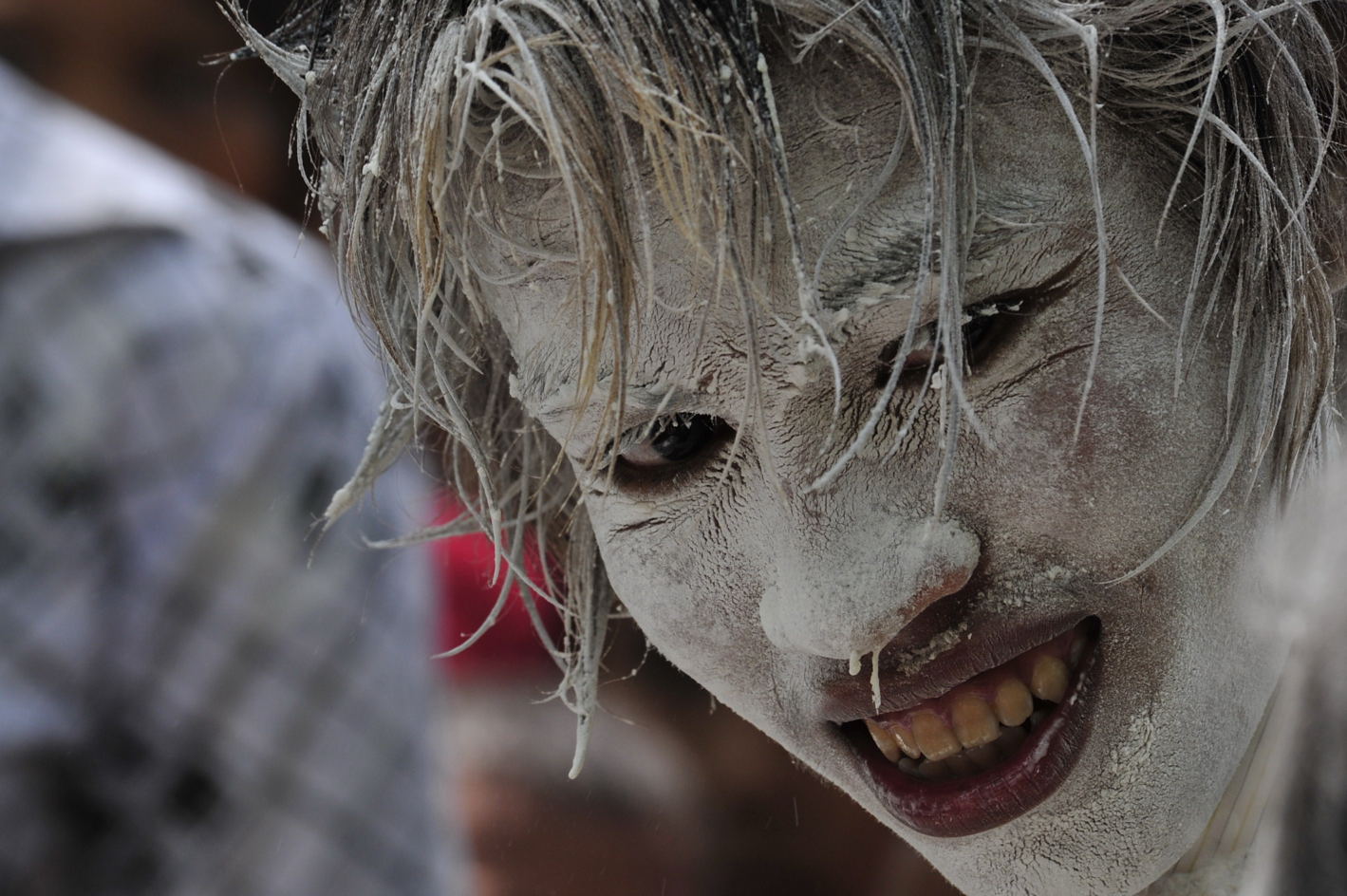
We spent a day cruising around country temples, taking part in the celebrations and enjoying the friendliness of locals. Nick tried to blow up balloons with darts (not a great success), we watched locals playing games reminiscent of pinata and greasy pole. We even stumbled into a wedding. Then we appreciated the religious side of Khmer New Year, witnessing the washing of Buddha and blessings by monks and nuns. We saw countless water-and-talcum powder fights going on amongst kids, but locals were reluctant to have us join in. Until a little girl came up to me and gently, on tiptoe smeared my neck and chest with talcum. From there started a whirlwind of smiles and giggles accompanied by clouds of talcum powder; all the children wanted to cover us with it. We had to run away from the crowd as we resembled something between snowmen and crazy bakers. We headed for the bamboo train, for a ride into the sunset. That's where I saw it; Angkor Wat may be amazing, but Cambodia's real treasure is its people.
Subscribe to:
Posts (Atom)