Sunday, 13 December 2009

Caipiroska


Following the coast of Brazil north-east from Salvador, the beaches become wider, the pace slower, the sun shines stronger. One could spend months exploring the seaside villages and colonial towns in the area; our next stop was Maceio, about nine hours north of Salvador. We were lucky to be able to stay with Roab, the aunt of my sister's friend Gulli, who lives in a villa by the sea in Guaxuma, one of the beaches north of Maceio. It was perhaps a little early in our travels to have a few days of relax by the beach, but it was surely a welcome break. On our arrival, Nick and I could not believe how beautiful the place was. It had just stopped raining, the sun was shining through a backdrop of palms on one of the best beaches I ever saw. The sea was slightly rough, the sunlight creating an array of colours which became almost pure light in the spray of the waves. There were still some pools of rainwater revealing the recent storm, fallen palm leaves and coconut shells were scattered throughout the beach. It was not picture-perfect; this is why I liked it.
Roab was a fantastic host. We had never met each other, so imagine my surprise when I discovered we couldn't communicate as she only spoke Portuguese, and my Portuguese was still lousy at the time. I have to say, had I not visited Roab, perhaps i wouldn't have learnt Portuguese. She is a beautiful woman, looking at least 15 years younger than her age, always immaculately groomed and dressed. I have to admit that I always felt ugly and scruffy next to her. However, by the time I was still new to Brazil, and I had not realised that the majority of Brazilian women (and men!) like to look beautiful.
Brazil is one of the places in the world where cosmetic surgery and orthodontistry are at their cheapest. I was amazed by the amount of young adults wearing braces, and when I enquired as to why a friend replied "they want to fix their teeth!" as it was the most natural thing to do. Later in my travels, I met girls dressed up to the nines in the backstreets of Sao Luis do Maranhao, leaving in crumbling houses but with impeccable hair and make up. Once, on an overnight bus, a woman looked at my baggy trousers and tangled hair and asked me how could I let my husband see me in that state, then tottered to the bathroom to fix her make up. Brazil struck me as a happy country; where sea, sun and music create smiles and friendliness, making the visitor feel welcome. And Brazilians like to show off! With a photographer husband, I timidly approached market stall holders, fishermen and people on the beach asked if they would mind having their picture taken. Nobody ever refused! On the contrary, most people behaved liked models at a photoshooting, posing under different lights and showing their best profile.

We spent our time in Maceio relaxing, walking up and down the beach, drinking beer under the shade of the palms and chatting to Roab. She could fix the best caipiroska I ever had, and soon what was supposed to be a quick drink turned into hours-long chat in my pidgin Portuguese. When it was time to go, we decided to stay a bit longer. The words of my Canadian friend Michele came back to mind; travelling is not about how many pins you have on the map, it's about the people you meet. I asked Roab if we could stay an extra day, she smiled and made us another caipiroska.

Acaraje


In the previous blogpost, the allusion to food was figurative rather than evocative. On the other hand, Salvador is a town whose identity is strongly linked to food; where centuries of history have created a microculture that best expresses itself through religion, music and indeed food.

Salvador was founded in the mid-XVI century by Portuguese settlers on the Bahia of Todos os Santos, which gives the name to Salvador's state. The name Bahia can also be used to refer to the city of Salvador. It was soon established as the first capital of colonial Brazil, as well as being the centre of the sugar industry and slave trade. As a result, when the slave trade ended in Brazil, many freed slaves settled in the area; thus creating a strong African-inspired culture, which persists to this day.

Bahia is perhaps one of the destinations which best represents the melting-pot of cultures typical of Brazil, being at the same time one of the iconic places which entice first time travellers to the country. As a Jorge Amado aficionada, I could not miss the opporunity to visit Salvador. Travelling up the coast from Rio I was filled with expectations of sampling Dona Flor's culinary delights, whose exotic names have certainly contributed to my lifelong attraction to Brazil. And I was not to be disappointed.

Salvador is a place which presents itself to the visitors with a series of layers. One may visit the city as a day tour, or for a couple of days, and not even remotely scratch the surface of what Bahian culture really is. Well, that can be said for a variety of destinations worldwide, but for Salvador even more so as there are not many must-see sights as such; instead the culture is what makes this place unique. In our case, 5 days were surely not enough, however having a great host surely helped. Russell was the first of a string of interesting characters that we encountered during our months on the road. A seasoned traveller, he found what many travellers take look for; paraphrasing Virginia Woolf, a place of one's own. Russell runs Barra Guest House, where we stayed during our time in Salvador. He was dedicated to helping every guest having a great time, and gave us great advice for experiencing the two things I was keen to keen to discover: Bahian food and a Candomble ceremony.

Ingredients of Bahian recipes reflect the African heritage of the town and its seaside location; fish, prawns, beans, coconut milk, chillies, and the most iconic ingredient: Azeite de dende (palm oil). Those who have read Amado's Dona Flor and her two husbands, would know how complicated typical Bahian dishes such as moqueca, vatapa and caruru are; prepared with carefully selected mixtures of spices whose recipes are handed from generation to generation. As such, not only recreating a recipe is nearly impossible, also conveying the flavour of Bahian cuisine in words is likely to be a formidable task. In my opinion, Bahian food is so strongly intertwined with the history and culture of Salvador that elsewhere it would simply not work.

Take acaraje, for example. Acaraje is a ball made with peeled and mashed black-eyed peas fried in dende oil, served split in half and filled with pimenta (a spicy sauce made from malagueta peppers), vatapa (a yellow paste made with manioc flower, dried prawns, coconut milk and again dende oil) and caruru (a greenish sauce which contains okra, onions, cashew nuts and yes you guessed it! Dende oil). Acaraje is probably the most iconic of Bahian dishes; it originates from West Africa (mainly the Igbo part of Nigeria) and it is prepared in the street by baianas, women dressed in white which are often identified by their first name: Acaraje da Dinha, Acaraje da Tania and so on. One dish, which conveys both the African heritage and the familiar, mother-to-daughter character of Bahian food. I had my first acaraje watching the sunset over the Farol da Barra (Barra lighthouse), accompanied by a cold beer. And I liked it so much that I had seconds, despite the fact that it supposedly was 2000 calories a pop. How was it? Well, go to Salvador and find out.

Saturday, 12 December 2009

Steak and Chips


Rio de Janeiro is indeed a marvellous city. I once asked my grandfather, a notorious globetrotter, which were in his opinion the most beautiful cities of the world. He answered almost without thinking Rome, Vienna, Constantinople (after all, he was born in 1918), Sydney and Rio. By that time I had visited all cities except for Rio, and now I can't help but agreeing with him on all fronts. But I am not here to bore you on how amazing Copacabana is, how beautiful the sunsets from Pao de Azucar are, how wonderful the view from the Cristo is. When I think about Rio de Janeiro, my memory goes back to Rocinha.

After a few days of marvelling at the aforementioned sights and enjoying the sun-kissed Carioca weather, we decided to visit the city's favela. Ironically, on the morning of our favela tour the weather was cold and miserable, almost London-like. I found strange, nearly amusing, the possibility of experiencing similar sensations in two places geographically and conceptually distant from one another. Yet again, I wonder if my feelings about Rio would have been any different if we had glorious weather all the time. From Paradise on earth to a city like many others, albeit one of the most beautiful there are. Surely my experience of Rio would have been different, more naive, had I not visited the favela.


Rocinha is the biggest favela in Rio de Janeiro, with an estimated population between 100.000 and 200.000 people. Most of you will know what a favela is. Perhaps many will have ideas of how such place would be. Favelas are shantytowns that have developed over the last century, some literally cheek-to-jowl with affluent neighbourhoods in the Zona Sul of Rio. The origin of the favelas can be traced back to the Uruguayan War in the mid XIX century, when land was promised to the soldiers in exchange for their participation in the war. When the promise was not maintained after the war, some soldiers occupied a piece of land where broad beans (fava in Portuguese) were grown. Others argue favelas are the modern development of quilombos, communities of slaves who ran away from the plantations. Whatever the origin, the population of favelas swelled during the 20th century as a result of migration from the countryside to the cities. It is now estimated that up to 30% of Rio's population lives in favelas.

Many object to this type of tourism, considering it exploitative and voyeuristic. Others wouldn't dream of visiting a favela, perhaps after watching the movie City of God which, funnily enough, was filmed in Rocinha. Personally, I beg to differ on both fronts. Firstly, considering the extent of favelas in a city like Rio, a find it hypocritical not to acknowledge their existence and limit myself to the charms of the Zona Sul. Moreover, revenue from the tour profits the community itself. As to the violence, we were told that favelas are indeed run by drug lords, but a precise set of laws apply to protect the residents: no unauthorized killings, no rapings, no muggings. At the same time, foreigners wandering through the favelas unaccompanied would also be perfectly safe. We experience that ourselves. Going through Rocinha market we lingered taking pictures, and lost the rest of the group. Nick had a Nikon D700 around his neck. The locals smiled and helped us finding the others.

What stroke me first about Rocinha was the magnificent view its residents enjoy. It is the only place in Rio where one can see Cristo Redentor and Pao de Azucar at the same time. What remains in my heart about the place is the friendliness of locals. A friendliness that is not there to hide a purpose to exploit the tourist, instead a smile that is there to say 'welcome to my home, tell your friends that here is not all about guns and blood, tell them and come back to see us'. Little boys played football in the street, little girls played dolls. I had my picture taken with a beautiful little girl. I could see her from the corner of my eye that her hands were moving; only later did I discover that she was signing a love-heart.


I felt, however, that not all could be as golden as it looked. Memories of City of God came back to my mind and I found myself thinking whether one of the boys playing football would meet the destiny of File com Fritas (Steak-and-Chips), the 8 years-old boy who was brutally murdered in City of God. I wondered if those children were also involved in the drug trade, whether or not their playing is as carefree as other children in the world. When we visited a school, I read the poems written by children which were on sale on cards. Nicole, 11 years, wrote a poem called 'A minha Escola'. So it goes: A minha escola tem sala para ler, tem sala para escrever. Ela e o maximo! Ela e amor. Ela e o remedio para a minha dor. Which translates as 'My school has a room for reading, a room for writing. It is the best! It is love. It is the remedy for my pain.
I wondered what sort of pain Nicole was talking about, and I cried.


Now Rio for me is the eyes of those children.


Change of direction

Those of you who have read this blog may have noticed I have not been a prolific writer at all. Searching my mind for an answer as why this may be, I have found two main reasons. First, internet connection in South America is notoriously inconsistent. That, by itself, is probably not an excuse. I have met several fellow bloggers who were not deterred by Bolivian dial-up nor by Cuzco's gringo-filled internet cafes and dedicated hours on end to let their followers know what antics they got up to in the land of the Incas. Personally, I preferred to explore Cuzco, or La Paz, or wherever I was.
The second, and probably the definite reason for my silence, is that I do not want to be a food blogger. During my time in Blighty I met several individuals who expected freebies, VIP treatment or a book deal on account of their culinary ramblings. There are enough wannabe Jay Rayner or AA Gill as it is, so let me entertain you with something different. From now henceforth this blog will be about mine and my better half's wanderings and pilgrimages in foreign lands, about what struck us the most during this time spent touring the planet.
However, I find myself unable to erase the Epicurean enjoyment of food from my writings. Thinking back to my time in South America from a comfortable chair in Richmond NSW, I find my memories inextricably linked to some sort of food or beverage. Like a trigger for reminiscence. So, let me entertain you with tales of my journey, once again starting in Rio de Janeiro.

Thursday, 30 July 2009

Rio’s street food

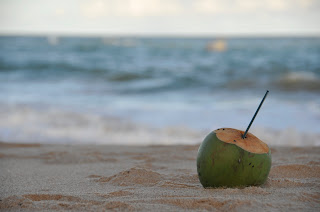
Our stay in Rio was rather short, but we discovered a lovely little secret place: Praia Vermelha, a small beach just at the foot of the Pao de Acucar, the Sugarloaf mountain. Not only the view of it from the beach is beautiful, especially at sunset, there is also a fantastic array of street food on offer. One afternoon we tried pretty much all of what was on offer. We had corn two ways; cooked corn on the cob with butter and fresh pipoca (popcorn), served either sweet or salty. For a ‘main course’, I had grilled cheese on a stick (queijo quente) which can also be enjoyed marinated in herbs. The Carnivore had ‘churrasco’, a skewer of beef chunks and linguica, a garlic sausage vaguely reminiscent of Toulouse sausages. Dessert was fried churros filled with doce de leite (absolutely delicious). They were slightly different from the Spanish version of churros I am used to, the dough is slightly lighter and they are filled, not dipped. They are absolutely delicious. All of the above was washed down with a cerveja for the Carnivore and a coco for me. Cocos are coconuts with the husk on, with a hole cut on top by a machete-wielding vendor. Similar to those found at Notting Hill carnival in theory, but much tastier in reality. The juice can be drunk before returning the coconut to the vendor which chops it open and cuts a bit of shell to scoop off the flesh inside. The image of a coconut with a straw might scream tourist, but Brazilians are the first to enjoy this beverage which contains electrolytes, useful to prevent dehydration after a day at the beach. The only street food we didn’t sample was beijinhos de tapioca, sweet or savoury tapioca pancakes which are a specialty of the Northeast, where we’re headed next.

Amazement in Brazil: Rio de Janeiro and Porcao

How can I start writing about a place as beautiful as a dream, a place I have dreamt about for almost a decade. Everything, from when the luggage tag with GIG on it was applied to my backpack, when we caught the first glimpse of light after landing at the airport, to when our bus approached the city at night time, felt like a dream becoming true. Having dreamt of Brasil since childhood, I had high expectations for Rio. And I was not disappointed. Exploring the place during the time we spent there, two words came to mind to define the place; kindness and simplicity. Kindness, gentileza, is a quality of Rio’s people. We found the people to be kind and welcoming, favela children are happy to offer a smile and casual passer-by are ready to give a helping hand. Simplicity, as Rio is beautiful in a simple way. The stunning backdrop of the city is one of the most spectacular on Earth, amid limestone hills and a bay that was mistakenly believed by the colonisers to be the mouth of a river (hence the name, Rio de Janeiro). Simple was also the best adjective to describe the food we were able to sample during our stay in Rio. Simple but delicious. Before leaving for this trip I made a vow not to fall into tourist traps; now, after only a week in Brasil, I am aware this is likely to be an extremely hard task. I care about my bowels too much to be enticed to try food from a dodgy-looking lanchonete. However, our first dinner in Rio was in a place which is not only a tourist trap, but also an amazing restaurant. I am talking about Porcao, THE churrascaria. A churrascaria, or rodizio (I am yet to understand the difference, if there is one) is a restaurant where meat is served to one’s hearts content. The meat is freshly grilled and served carved from a sword. There was also a salad and sushi bar included in the fare, but neither of us decided to partake from it. We wanted to have as much meat as possible. The buffet, however, did look interesting; featuring seared tuna with cayenne pepper and passionfruit sauce, mozzarella rolled around sundried tomatoes and basil and mango salad with toasted sesame and nigella seeds amongst many others. The meat was memorable. A piece of sirloin was truly the most amazing piece of meat I ever had in my life. It was perfectly rare inside, but not oozing blood, grilled with merely a smear of salt, pepper and olive oil. The meat itself had that distinctive taste that only South American grass-fed free range beef has. Carnivores in Rio, go there. That’s all I can say. Other highlights included skirt, picanha (the cap of the rump, Brasil’s favourite cut of beef), the interesting ‘baby bifi with garlic’ (another piece of skirt smothered in garlic paste) and ostrich in parsley sauce. Pork was delicious too, especially ribs and what we named ‘pork potatoes’, a piece of loin marinated in lemon, garlic and thyme. We left R$200 (about £65) poorer, but happy.

Saturday, 11 July 2009

My London

As the day of our departure approaches, here are my London favourites for you.
I guess only know I can fully appreciate what this great city has to offer, as nostalgia becomes more and more palpable each day.

10 great London experiences:
1. The Albert Bridge at night time
2. South Bank at sunset
3. Admiring the City from the top of St Paul
4. Walking along the Regent's Canal, from Camden to Little Venice
5. Looking for deer in Richmond Park, and then finding scores of them grazing together
6. Exploring a market, Portobello is my personal favourite
7. Hyde Park (my park) on a sunny Sunday afternoon
8. Sunrise over the Thames, Battersea Bridge and Battersea Power Station are magical
9. Visiting a neighbourhood like Brixton or Southall and then understanding why London is 'the world in one city'
10. Hearing Big Ben chime

My favourite 10 gastronomical experiences:
1. South Indian at Hot Stuff, Vauxhall
2. North Indian at Tayyabs, Whitechapel
3. Roast and crispy duck at the Four Seasons, Bayswater
4. Sushi at Sushi Say, Willesden Green
5. Pizza at Franco Manca, Brixton
6. Tapas at Barrafina, Soho
7. Rib for two (with peppercorn sauce, chips and bearnaise) at The Butcher and Grill, Battersea
8. Anything at St John
9. Visiting a secret restaurant (more to come on this subject)
10. Borough Market, especially Brindisa's chorizo